The Copenhagen Neuroaesthetic Conference
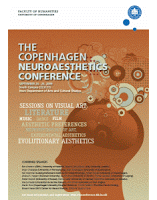
This past Sept 24-26, 2009, the University of Copenhagen hosted their first Neuroaesthetics Conference. I found out about it last March and went through a lot of trouble, ie. reading, to put together a poster submission. My reading was unstructured and all over the board. I made it fit.
As the second week in September rolled around, I knew it wasn't happening. Understandable. I haven't written a science anything since high school. Of course I was out of my league. They were rats for not at least sending a rejection letter, just for courtesy's sake.
Late Tues. night, Sept 15th, I get the e-mail: Congratulations. You're poster's accepted. The conference is next week. We had some technical problems..Sorry. !!!
Sept 16, finish painting living room/juggle Credit cards, buy a ticket, Sept 17 finish painting the livingroom for real, take down my largest art show, Sept 18, pull out notes from March, relearn, Sept 19, borrow a mac, learn mac, make a poster, Sept20 print poster, pack. Sept 21, leave.
What follows is the most wonderful time of my life, which is why I have no idea how to write about it properly. The conference organizers are Soren Kaspersen, Jon O. Laurig, and Martin Skov. The quality of company and conversation throughout the presentations and into the pubs is of a rare caliber.
A whole review is being written by a much more knowledgeable participant. I will revisit different aspects of the trip in a more stream of conscious way. The speakers are amazing. The subject matter is intriguing...and sometimes a little over my head. I will start with Helmut Leder's talk...tomorrow.
My reading:
My favorite, Gerald Edelman, neurobilologist writes on "Neural Darwinism" and consciousness. Denis Dutton is a philosopher whose book, Art Instinct, is a dry read with ideas that stick. James Elkins, an art historian delves into the element that triggers people to weep before works of art in Tears and Pictures. He came up w/a tidy list of visual triggers which I reviewed and discarded as I welled up at the MET in front of a bunch of Monets... so irritating... Jonah Lehrer has great articles in SEED magazine. Of course it all starts with Semir Zeki one of the forerunners of neuroaesthetics.

Fly Away Fly Away, Weathering the Storm
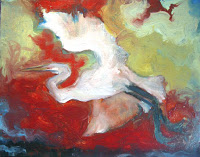 ries like this. Retail says, if you sell one thing, have similar stuff for people. People like familiar.
 My paintings share themes but are often different in content and style. Painting time is lean. My work schedule has never been pretty. This leads to small paintings, slow evolutions for larger pieces, and ideas that sit in wait.
I revisit an older painting for the path that leads to paintings I've just finished. Even if I have new ideas, the older ones demand completion.
I am wary about telling this painting's story. It's not pleasant.
Aug 2005 Hur
 ricane Katrina-(you see?)
Me - working a restaurant beyond security in the airport- Logan Boston Int.. All four TV screens on CNN's blow by blow Katrina updates.
The Delta jet shuttle between Boston and NY is the regular audience...very nice business suits. I go home via Paul's Parking Shuttle...very different shuttle... sometimes the breaks don't work. At home I continue to watch and cry for a hopeless situation. How terrifying - no escape!
I begin my painting with a bird on the wing with the storm at its back and a woman gathering unripe oranges from a potted tree. Birds and flowers are the key in many of my paintings. Wild vs. Tame..The wild can flee at least.
As the newscasts continued, the line between survivors and sufferers was clear. It is money. Apparently birds aren't the only free things...so are the wealthy. A new heightened awareness of such divisions filters into my daily life. I watch the business shuttle crowd back and forth, blithely batting at their blackberries waiting in line to jump to the next city. And the airport workers, many from hard luck parts, thinking an airport job was golden... it had benefits ..but fighting every day for that extra shift, figuring out child care or bills or how to change their life either by school or a race horse. I am one of them. If anything beyond the regular happens- our lives turn upside down. A missing baby
 sitter or a car problem puts a job in jeopardy. The job is everything, no matter how horrible it is.
My painting grew business men...and a plane.
I don't think I finished this until 2007. Touching the painting made me sad. The philosophers and psychologists all talk about the beauty and pleasu
 re art brings. They attest that pleasure is what drives the production of art. Where can my send a letter of dispute?
I often wonder why I paint such things. I called on a higher power for a proper finish. The painting emerges from a watery wash of bright reds to rich dark earthy tones, thick lines, ...Diego Rivera used these heavy lines in his paintings of peasants, farmers, business moguls, politicians, the poor and the powerful...It is appropriate. I think he would approve. I wanted him in on this painting.
On the way through this painting all related things showed themselves. As I watched some struggle, I saw strength. As I watched others create turmoil, I saw their weakness. The political system in place did homage to the Dark Ages with Intelligent Design and religion as righteous mask to underhanded business.
This painting leads me to ideas of medieval thought process in contemporary times. My next paintings lay in wait of a day off.
Why I'm a crummy blogger
 I'm a crummy blogger because I actually have great adventures all the time and I have a really wacky job too. I just don't follow up with the writing part...no tiny laptop, no i-phone, no attention span for computer glowing screens. In between adventures I clean my apartment (because adventures inevitably lead to giant messes) and try to paint or at least organize the next adventure...
For the past year and a half I work as a scenic painter for film and TV. This is very exciting to people who like celebrities. It is exciting for me because I get paid
 a living wage to mess with paint. I won't go into any job details as I am forever signing contracts with threatening verbiage in them about the consequences of leaking important confidential information about their top secret projects... like the next "great" re-make or the latest chick flick...very important stuff.
The top picture is in a Navy yard studio in Brooklyn. Behind me is a classic water fountain they imported from Italy for a show. The middle picture is a carpet of plastic green turf, thousands of dollars worth, that covers a naturally sparse Essex County lake front. The turf will be lightly shredded to make it "naturally" uneven and then sprayed w/shades of green and brown to make it "naturally" toned....naturally! And lastly-a big fake tree.

Bouncing between NYC and Boston, 12hr days, sometimes 7 days a week is tricky. Reading takes the place of painting. Not best sellers though..Things like Dr.Edeleman's Wider than the Sky about consciousness, D.Dutton's Art Instinct and E.Dissanayake's HomoAesheticus. An LA boss of mine loved to give me shit about being smart at coffee break(of course I corrected him...It's pronounced "Smott" around here.)
Why art...
 vocation is this, an artist? No structure, save the restrictions of the medium and the voice in your head that says “Stop, before you ruin it!” There is certainly no financial security. Making art is scary. The artist creates in pursuit of the perfect translation of information, from the intellect to the physical. There is only the drive to reinterpret life.
 There are the life basics: food, shelter, reproduction. This is survival. For most animals, motion deals strictly with acts of survival. For the human animal the drive to create products outside of a given natural environment seems both unnatural and human at the same time. This strange use of energy defines the quality of life, how one survives and grows. The artist observes the existing structure with a critical mind, internalizes the experience, personalizes the idea with an individual voice. The input transforms into the idea. The idea evolves into a plan. The plan sets the cue for motion. The motion results in the creation of a product.
The product is a visual constant with an emotional trigger. Art introduces emotions, ideas, and experiences that open up new paths in ways of thinking. Visual experiences create a space for emotional and intellectual research and reevaluation of hypothetical experiences.
As an artist, I am not a natural. With each painting comes more experience with the medium and new visual possibilities. The new possibilities make a beginner of me all over again. A successful image needs balance between message and medium, familiarity and ambiguity. This balance allows my voice and the viewer’s own interpretation to be equally valid. The figurative nature of my work makes it accessible. Subjects such as birds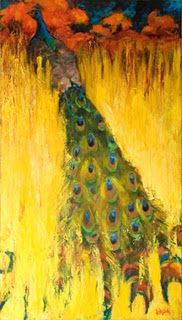
Part researcher, part storyteller, I offer my personal vision to the community. The work does not demand a one-sided spotlight, but invites the viewer into an intimate exchange of ideas. The work invokes participation and interpretation. It is a dynamic visual dialog. This is a special type of social interaction, one that looks for immediate emotional and intellectual response.
Emotion controls attention. Attention controls sight. Sight controls movement and action. Every action is proceeded by motivation, a plan. Every action brings one into a new environment. Every environment induces a flurry of thought, recall, mapping, and adjustment. Art provides a stimulus different from those in the natural environment of survival. Art invokes social interaction different from the interactions of basic survival. If emotion drives our thought process, art brings it full circle. Art is not a decoration. Art is the equipment that aids our evolution and provides a higher quality of life.
My First Science Paper:
(A lot of people got a kick out of my first science paper ever. I'm still taking suggestions - D'Lynne I know you're out there. This is my submission to a neuroaesthetics conference in Denmark...)
The first homosapien to transition to higher consciousness may have been the artist. 40% of our brain’s neurons are dedicated to the visual brain. It is a particular individual that is predisposed to physically reinterpret the effects of visual qualia into an original product. This product, visual art, nurtures the growth of complex ideas through neural connections. Society’s visual citizen provides the community with a necessity, the neural catalyst.
As others create schedules based on daily needs, the artist stops and fixates on visual stimuli not connected with immediate survival needs and actions. This qualia observation connects with memory, emotion, or hypothetical ideas and induces focused reentry. This contemplation breaks the individual from the “remembered present” through active intellectual investigation.
The artist translates the perceptual memory and related ideas into visual metaphors to be reinterpreted by an audience. Many layers of visual content create ambiguity that calls on all parts of the viewer’s brain to interpret meaning. Art does not cater to just the mid-brain (emotional brain) as traditionally believed, or even to specific areas of the brain. Viewing art caters to the process of reentry. It strikes the cerebellum with an emotional jolt. It calls on the cerebral cortex to assess novelty and reassess expectations. The reentry connects new visual info to the viewer’s personal intellectual history. A concentrated gaze allows for contemplation of constant stimuli. This constant puts saccades and the brain’s need to constantly construct time/space to rest and allow other areas of the brain more activity. The viewer instills a personal timeline, unlike the spoken/written language which structures the release of information in grammar and controlled time sequence.
Since it marked a turning point in evolution and intelligence in early homosapiens, art has never faded as a sign of humanity and communication. The more we study the workings of the brain, the more we know that our thoughts are emotion and metaphor based. The more we learn about our physical realities, the more we may find that the written word may not be enough. We may need a visual aid that touches all parts of the brain at once. Preparation through surrogate experiences, reassessing expectations, and the quieting effect of the visual constant are all ways visual art readjusts neuro-pathways and the individual’s thought process. Visual contemplation of artwork is the catalyst for complexity of ideas and with it strengthens society with innovation.
Jesus made me do it...
http://seedmagazine।com/content/article/the_future_of_science_is_art/
Wow! I am not a computer person. I have a blog because I couldn't figure out web sites. I left the blog alone, not because I wasn't doing anything, I just couldn't figure out how to post links...until now(I walk away when I get aggravated)... and then I briefly lost the ability to type in English.
When I was a high school freshman, I had to choose between art and science, my two favo
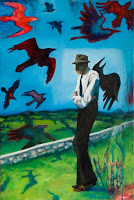 rites. The problem was Jesus. I was in a catholic high school and religion was a staple class. There was not enough room for Jesus, Darwin, and Monet. I chose art. Until now I've been missing the science.
Jonah Lehrer, a writer for my favorite magazine, SEED, spoke about his book, "How We Decide". It is his writing that hooked me into all of the new science. I've posted an article that introduced me to the new bridge growing between art and science. Neuroaesthetics is the study of the biological need for art making/viewing. Much like someone studying psychiatry to fix themselves, I am reading up on neuroaesthetics to find the root of my own "affliction".